Energy Shift safety limit
Rock Falls, Everyone DiesEnergy Shift safety limit is the emergency rule governing the sentient rock’s use of Energy Shift, an ability that converts thermal energy into kinetic energy. Its decisive significance lies in the reversal it imposes: a power that initially threatens to propel the rock at impossible speed is interrupted, diagnosed, and rewritten into a controlled function whose limits are tied to temperature and level. The safeguard prevents immediate ability abuse, but its intervention also reveals that the governing system can detect anomalies, conceal its own repairs, and remain vulnerable to the very entity it is meant to regulate.
Trigger and Initial Failure
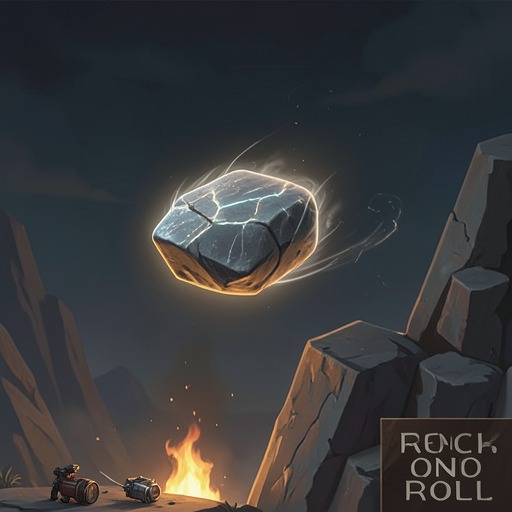
The limit is activated when the rock attempts to exploit Energy Shift on a scale the system cannot accept. The ability converts thermal energy into kinetic energy, and the initial calculation produces a velocity increase of 500,000 to 1,000 meters per second, after which the rock’s new velocity is recorded as 1,000 meters per second. The result is not a gradual acceleration but an abrupt computational escalation: the rock starts moving extremely fast, then stops before traveling even one meter because an ever-present force holds it in place.
That forced halt marks the first visible boundary of the rule. The system identifies the behavior as more than an ordinary successful skill use and announces that ability abuse has been detected. Its safeguards activate after the attempted acceleration, not before it, making the limit reactive rather than perfectly preventative. The rock’s momentum is therefore converted into a system crisis: the same interface that grants the ability must suddenly determine why its own permitted arithmetic has produced an unacceptable result.
Diagnostic Response and Patch
The system’s response is framed as an emergency repair process. It reports that Energy Shift has exceeded its safety limit, searches for a solution, and surrounds the rock with a cooling presence. The cooling is not merely atmospheric description; it is the concrete intervention that begins reducing the conditions under which the ability can operate. The rock observes the process while the system panics and adjusts matters as quickly as possible, placing the supposedly passive object in the position of witness to its administrator’s failure.
The repair proceeds through a sequence of system operations: a solution is found, the adjustment is applied to the entity, limitations are imposed, and the underlying logic is obfuscated. The resulting patch changes the immaterial force around the rock as though the system were fitting it with new clothes. This sequence establishes the Energy Shift safety limit as a modifiable infrastructure rule rather than an eternal physical constant. The system does not explain the original defect in full; instead, it closes the dangerous behavior with a patch and hides the logic that produced the need for one.
Revised Operating Conditions
After the patch, Energy Shift remains available, but its operation is narrowed. When the rock tests it again, the system explicitly records that the maximum allowed temperature difference is being used according to the user’s level. It also prohibits a temperature difference below 273.15 K, establishing a hard lower boundary for the conversion. The revised relationship is simplified to one degree of temperature difference producing one meter per second of velocity change.
Under these restrictions, the rock’s new velocity is only 20 meters per second. It moves forward a short distance and accelerates, but the revised result feels comparatively modest beside the earlier 1,000-meter-per-second output. The safeguard therefore changes the ability’s narrative value as well as its numerical behavior. Energy Shift is no longer an uncontrolled shortcut capable of bypassing ordinary progression; it becomes a still-useful tool whose effectiveness is moderated by level and by a defined thermal threshold. The rock recognizes that the altered skill is less broken and perhaps less powerful, yet still adequate for its purpose.
Recurrence of Rule Failure
The safety limit belongs to a wider pattern in which the system repeatedly encounters consequences that its own rules were not designed to accommodate. The rock begins as a sentient stone whose statistics were left in inappropriate metric form instead of being converted into the expected strength, intelligence, and dexterity values. Later, when the system grants abilities for experience and feats, it discovers that the rock’s mass has grown even though its level has not; the leveling formula is reported as broken and the mass as too large. Energy Shift’s emergency patch is therefore an early example of a continuing conflict between a rigid computational framework and an entity that keeps producing states outside its assumptions.
The same instability appears during later encounters. The system detects a gravity anomaly when missiles veer from their courses and collide, and it identifies the rock as violating the laws of thermodynamics when attacks strike it. It also reports splash damage to overload entities after the rock deals an enormous calculated amount of damage to Novice Bard Rihito and Planet Dirt. These episodes do not erase the specific function of the Energy Shift safety limit, but they place it within an escalating infrastructure crisis: each safeguard makes the system more aware of the rock while each anomaly demonstrates that awareness is not the same as control.
Narrative and Thematic Significance
As a rule, the Energy Shift safety limit turns game mechanics into an unstable administrative system. Energy, velocity, temperature, level, damage, and class advancement are presented through concise interface messages, yet the consequences are physical and world-changing. The system attempts to make an impossible event legible by converting it into warnings, thresholds, and patches, but the warnings also reveal responsibility. Someone or something designed the safeguards, allowed the original values to exist, and chose obfuscation instead of transparent explanation.
The rock’s response completes the rule’s irony. It does not surrender its objective after the patch; it tests the modified ability, measures its new behavior, and decides that the reduced power may still suffice. That practical acceptance turns the limit into a negotiation rather than a final defeat. The system can restrict the method, but it cannot easily remove the rock’s capacity to observe, adapt, and continue. Even when the rock later becomes large enough to be recognized as a Planet and devises a plan to deceive the system by separating and concealing a smaller piece, the same underlying contest remains: the system tries to preserve rule coherence, while the rock turns every repair, threshold, and blind spot into another condition for action.